The Contribution Shift Language Guide
Shared language helps people see what would otherwise remain vague. This guide gives teams and organisations a practical vocabulary for contribution through others, CMMO®, leadership maturity, trust, culture, and organisational growth.
Take the Enhanced CMMO® TestBack to CMMO®Quick navigation
Core Contribution Shift language
The Contribution Shift
The move from contributing mainly through your own direct effort to contributing increasingly through others.
Simple form: from personal output to wider influence, stewardship, development, and multiplied contribution.
Contribution Through Others
Creating value not only by what you personally do, but by what you enable, strengthen, clarify, and multiply in others.
This is the heart of leadership maturity.
Stewardship
The practice of strengthening people, systems, and environments so they become healthier, more capable, and more sustainable over time.
Stewardship is quieter than authority and deeper than control.
Contribution Lens
A way of looking at leadership, culture, change, performance, and organisational maturity by asking what people are being enabled, expected, rewarded, or prevented from contributing.
Key question: what is the organisation actually enabling people to contribute?
CMMO® and contribution maturity
CMMO®
CMMO® stands for Contribution Maturity Model for Organisations. It helps people, teams, and organisations understand how contribution develops over time.
CMMO® does not replace CMM, CMMI, or ISO 9001. It strengthens the behavioural and cultural layer that helps those maturity efforts become lived practice.
Contribution Maturity
Contribution Maturity describes how well people, teams, and organisations are able to contribute in ways that are reliable, shared, systemic, and multiplying.
Contribution Maturity asks how mature the way of contributing has become.
The Contribution System
The set of conditions that make contribution easier or harder inside an organisation: Clarity, Responsibility, Authority, Flow, Trust, Capability, and Follow-through.
It asks what the organisation is making easy, what it is making hard, and what patterns it is repeatedly teaching people to use.
Contribution CRAFT
Clarity, Responsibility, Authority, Flow, and Trust. CRAFT is supported by Capability and Follow-through.
CRAFT is the practical CMMO® diagnostic lens.
Process Theatre
Process Theatre happens when an organisation has the visible signs of maturity without the lived behaviour of maturity.
The process exists on paper, but contribution has not matured in practice.
Contribution Change
The human and behavioural shift required inside an operational change.
Key question: what are people now being asked to contribute differently?
Layers of Contribution and the Glass Onion
Layers of Contribution
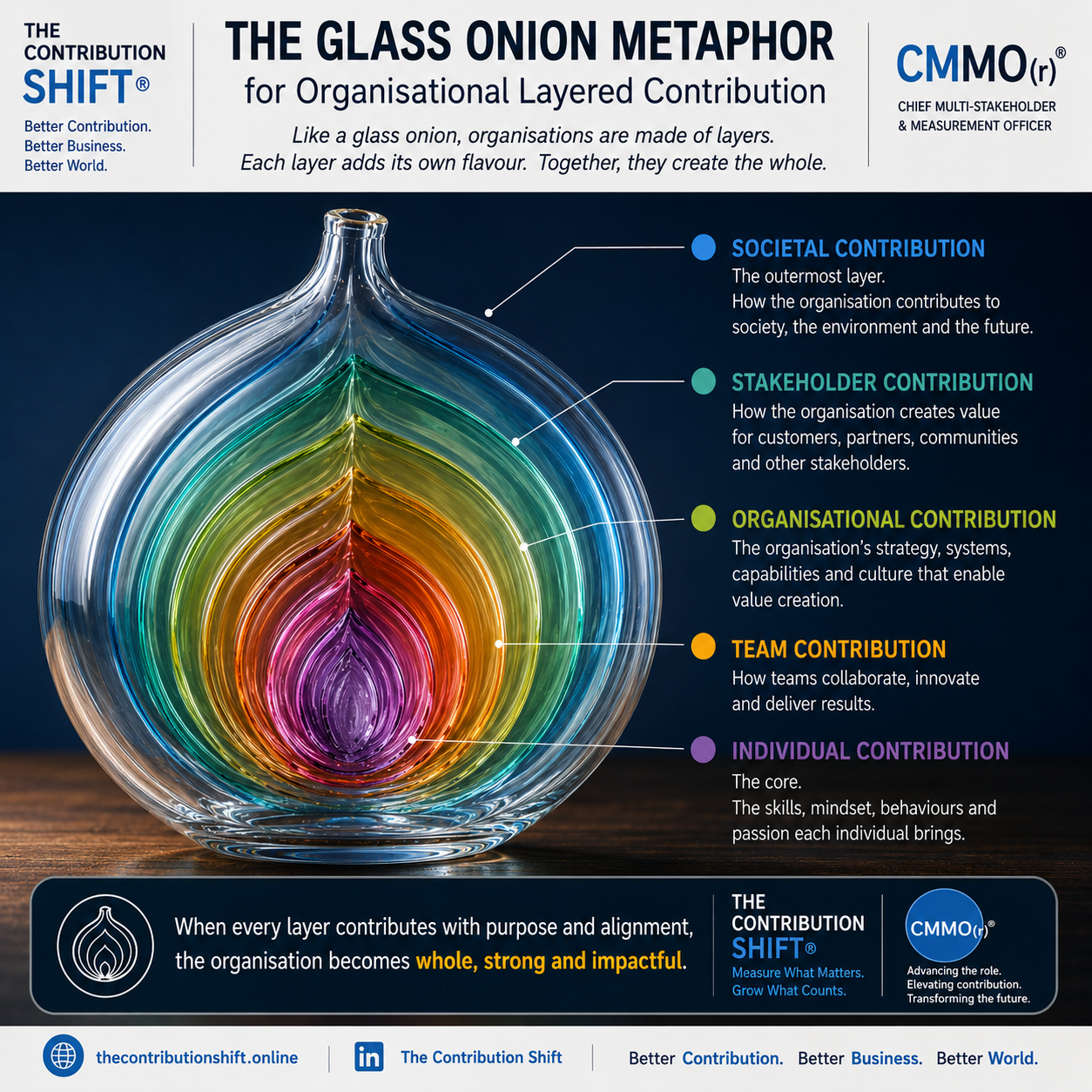
The layers describe where contribution is being shaped and seen: Individual Contribution, Team Contribution, Organisational Contribution, Stakeholder Contribution, and Societal Contribution.
The maturity levels show how contribution develops. The contribution layers show where contribution is being shaped.
Organisational Culture as Layered Contribution
Culture is the layered pattern of what people contribute, what they hold back, what leaders enable, what teams normalise, what systems reward, what gets challenged, what gets avoided, and what gets repaired.
Culture is what contribution becomes after every layer of the organisation has shaped it.
The Organisational Glass Onion
Like a glass onion, culture can be seen through, but only partially. Each layer reveals something and distorts something.
The Glass Onion helps leaders see culture as layered contribution rather than one simple thing to fix.
Leadership growth language
Leadership Intelligence — LI
Leadership Intelligence is the ability to turn personal capability into contribution through others.
IQ helps you solve problems. EQ helps you understand people. Leadership Intelligence helps you create the conditions where people can contribute well together.
Growth Before Promotion
The principle that people should develop the maturity required for broader leadership before they are promoted into it, not merely after they begin struggling in the role.
Premature Promotion
The movement of someone into broader leadership responsibility before they have sufficiently developed the maturity required for it.
Over-Functioning
A pattern in which a leader carries too much of the work personally, intervenes too quickly, rescues too often, or remains too central to the functioning of the team.
Hero Culture
A culture that rewards rescue, visibility, and personal centrality more than shared ownership, system strength, and sustainable discipline.
Maturity Cannot Be Installed
Maturity does not arrive because a framework was purchased, a methodology announced, or a training program rolled out. Maturity grows through repeated behaviour, trust, discipline, development, and reinforcement over time.
Trust and practice language
Trust Token
A small deposit into the trust account between people. Trust usually grows token by token.
Trust Bridge
A relationship strengthened through repeated, human, disciplined conversation. Strong Trust Bridges can carry pressure, disagreement, correction, and hard conversations.
Postcard
The impression left behind after an interaction. Over time, those postcards become your reputation.
One Page Development Plan
A living, practical growth document owned by the individual. It helps people grow with clarity.
Signal Perch
A trusted place or mechanism where someone can signal early that something matters.
Mycelium
The hidden organisational network beneath visible results: trust, review discipline, mentoring, one-on-ones, shared language, honest conversations, and stewardship.
Why this language matters
Language does not change an organisation by itself. But it makes change easier. When people can name what is happening, they can address it more honestly.
Shared language creates shared attention. Shared attention creates better choices. Better choices, repeated over time, become culture.
Assess contribution maturityAsk the Mentor