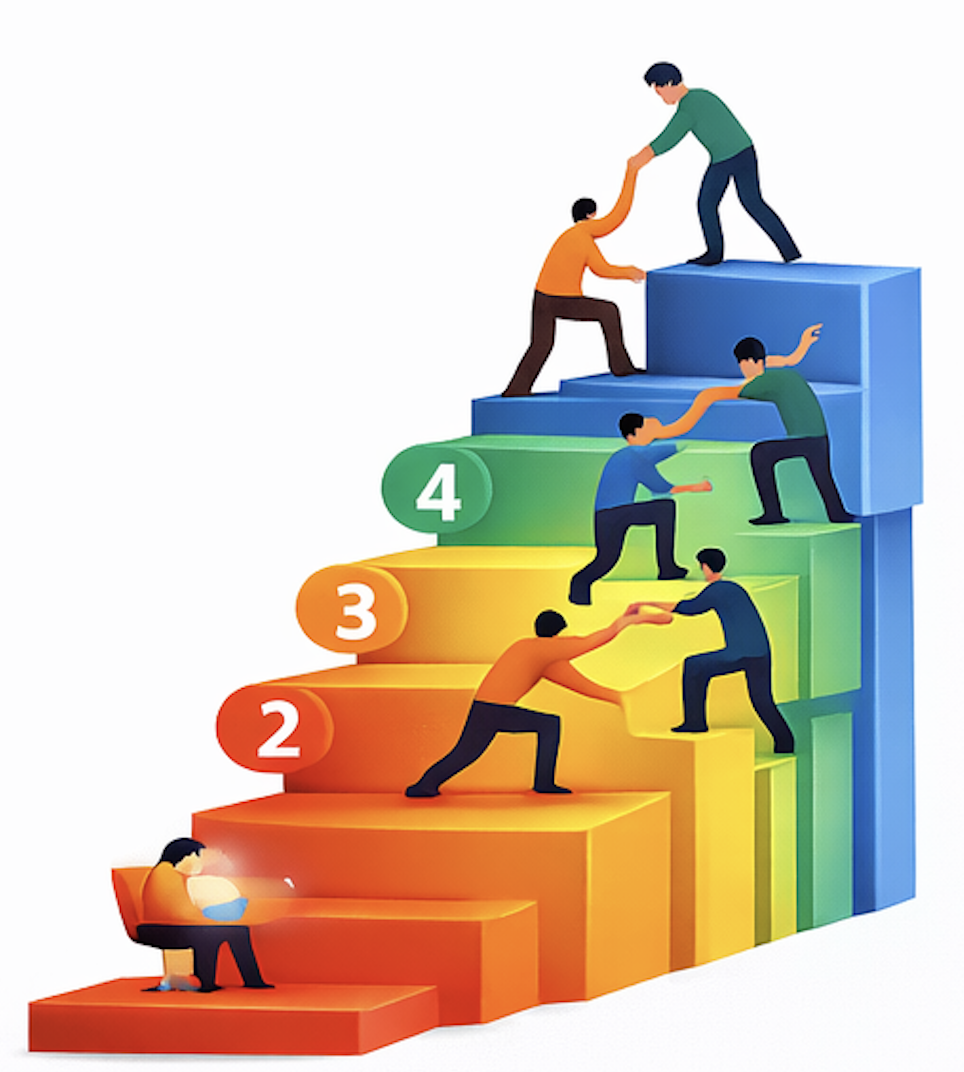
CMMO®
A practical maturity model for testing and improving how contribution grows across people, teams, leaders, organisations, stakeholders, and society.
CMMO® asks one practical question: how mature is the way contribution happens here?
CMMO® is not a rival to CMM, CMMI, ISO 9001, or other serious maturity disciplines. It is the behavioural and cultural layer that helps those disciplines become lived practice instead of process theatre. It helps explain whether contribution is still mainly individual, or whether it is becoming more shared, more systemic, and more multiplying.
What CMMO® is
CMMO® stands for Contribution Maturity Model for Organisations. It is part of the wider Contribution Shift framework and provides a practical way to describe how contribution matures over time.
At lower levels, work depends heavily on personal effort, heroics, escalation, and individual reliability. At higher levels, contribution becomes more shared, better supported by systems, more honest about problems, and more effective through the growth and capability of others.
The enhanced CMMO® model combines the five maturity levels with the seven conditions of contribution. The core conditions are captured through CMMO® Contribution CRAFT: Clarity, Responsibility, Authority, Flow, and Trust — supported by Capability and Follow-through. In simple terms: CMMO® = five maturity levels × seven contribution conditions.
The aim is not to give the organisation a flattering label. The aim is to make the next useful maturity shift visible.
Why it matters
Many improvement efforts focus on process, tools, structure, or compliance. Those things matter. But they often stall because the behavioural and cultural layer underneath them is weak.
CMMO® helps organisations look underneath the visible system and ask whether clarity, responsibility, authority, trust, capability, flow, and follow-through are actually supporting contribution.
Where it fits
CMMO® is not a replacement for process maturity models such as CMM, CMMI, or ISO 9001. It complements them by strengthening the human contribution layer that helps process maturity succeed.
In other words, CMMO® helps organisations improve not only what the system says, but how people actually contribute inside the system.
The Organisational Glass Onion
The Glass Onion helps explain why culture and maturity can be difficult to see clearly. Culture is not one thing. It is layered contribution: what people contribute, what they hold back, what leaders enable, what teams normalise, what systems reward, what gets challenged, what gets avoided, and what gets repaired.
Culture is what contribution becomes after every layer of the organisation has shaped it.
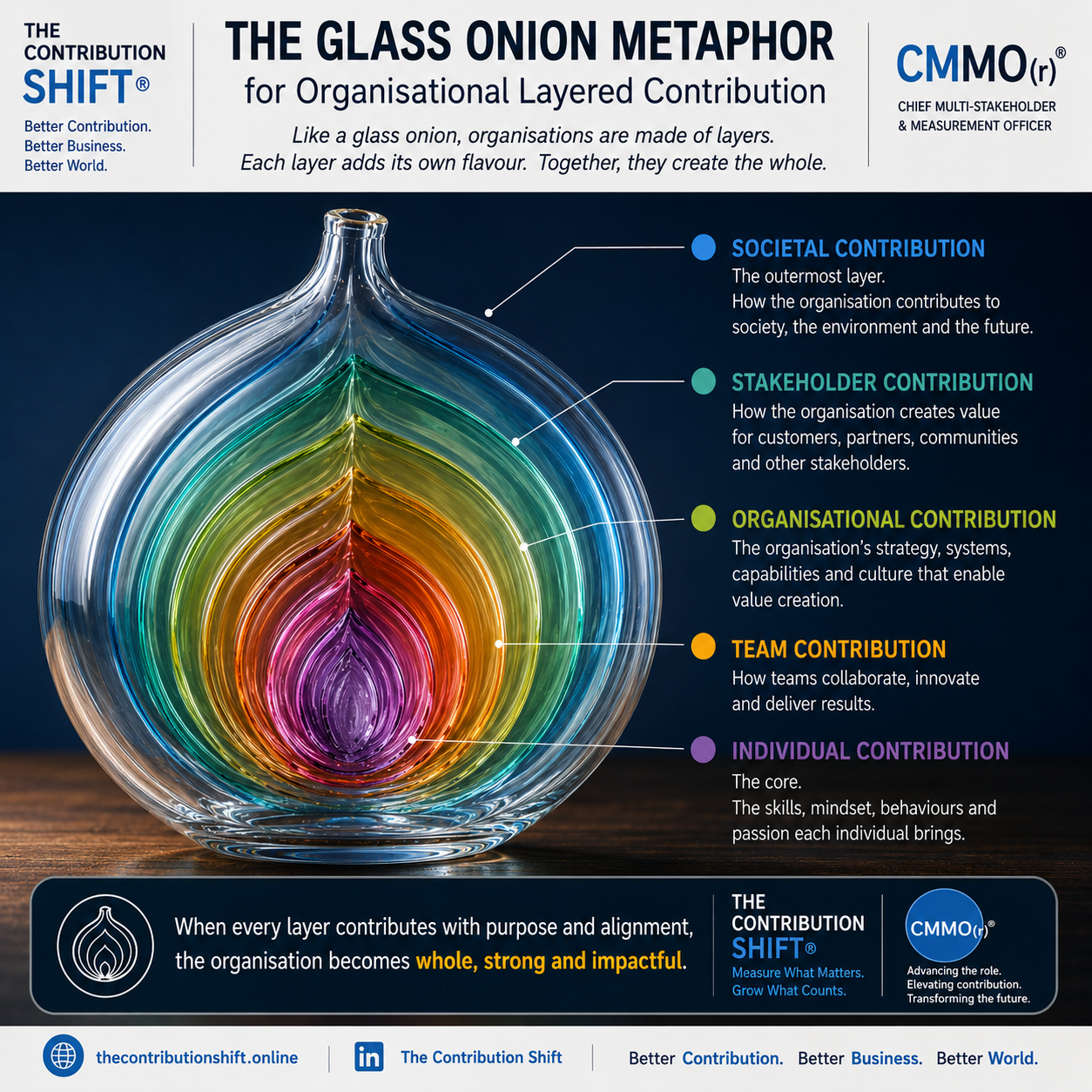
CMMO® reads maturity in two directions
Vertically, the five maturity levels show how contribution develops: Personal Output, Reliable Delivery, Shared Contribution, System Contribution, and Multiplying Contribution.
Outwardly, the five contribution layers show where contribution is being shaped and seen: individual, team, organisational, stakeholder, and societal contribution.
The maturity levels show how contribution develops. The contribution layers show where contribution is being shaped.
Individual Contribution
What people bring through their own effort, judgement, capability, responsibility, and follow-through.
Team Contribution
What people create together through trust, clarity, shared responsibility, practical development, and reliable coordination.
Organisational Contribution
What the organisation enables, reinforces, rewards, blocks, avoids, repairs, or normalises.
Stakeholder Contribution
How the organisation creates value for those who depend on it, work with it, fund it, regulate it, supply it, partner with it, or are affected by it.
Societal Contribution
How the organisation contributes to the wider human, ethical, environmental, professional, civic, and community context.
The five maturity levels
Personal Output
Contribution is mainly task-focused and dependent on individual effort, knowledge, and persistence.
Reliable Delivery
People become more dependable and accountable, but contribution can still remain narrow or siloed.
Shared Contribution
Knowledge sharing, teamwork, coordination, and mutual support become stronger and more normal.
System Contribution
People improve process, address root causes, and strengthen the system rather than just coping with it.
Multiplying Contribution
Capability is built in others, leadership leverage grows, and contribution increasingly happens through others.
The Contribution System
The Contribution System is the set of conditions that makes it easier or harder for people to contribute well. It sits between individual leadership behaviour and wider organisational culture. When these conditions are strong, contribution becomes clearer, safer, faster, and more scalable. When they are weak, organisations often blame people for problems the system helped create.
The craft of contribution
CMMO® uses Contribution CRAFT as a simple way to remember the core conditions that shape how well contribution works in an organisation.
Clarity
People know what matters, why it matters, and where attention should go.
Responsibility
People know what is theirs to carry and what needs to be shared with others.
Authority
People can act at the right level without unnecessary permission or escalation.
Flow
Meetings, handoffs, decisions, and processes help work move.
Trust
People can speak honestly, challenge safely, and learn without self-protection taking over.
CRAFT is supported by two further test dimensions: Capability and Follow-through. Capability asks whether people are being developed for the contribution expected of them. Follow-through asks whether commitments are sustained long enough for trust and improvement to build.
In simple terms: CMMO® measures the craft of contribution — how well an organisation creates the conditions for people to contribute through others.
Clarity
People understand what matters, why it matters, and where attention should go.
Responsibility
People know what is theirs to carry and what must be shared with others.
Authority
People can act at the right level without unnecessary permission or escalation.
Trust
People can speak honestly, raise risks, challenge assumptions, and admit uncertainty.
Capability
People are being developed for the contribution expected of them, not just judged against it.
Flow
Meetings, handoffs, decisions, and processes help work move instead of slowing it down.
Follow-through
Commitments are sustained long enough for trust, confidence, and improvement to build.
How the enhanced CMMO® test works
The enhanced test looks at maturity through the five CMMO® levels and the seven contribution conditions. In simple terms: CMMO® = five maturity levels × seven contribution conditions.
Assess the conditions
Review clarity, responsibility, authority, flow, trust, capability, and follow-through.
Identify maturity
Look for whether contribution is personal, reliable, shared, systemic, or multiplying.
Find weak points
Separate people problems from contribution system problems before choosing action.
Turn insight into action
Use the results to shape team conversations, leadership development, and improvement work.
CMMO® maturity and contribution conditions
| Condition | Level 1: Personal Output | Level 3: Shared Contribution | Level 5: Multiplying Contribution |
|---|---|---|---|
| Clarity | Priorities depend on urgency, noise, or individual interpretation. | Teams share a clearer view of what matters and how they contribute. | Clarity is actively maintained across teams, leaders, and changing conditions. |
| Responsibility | Work is carried by whoever steps up or feels responsible. | Responsibility is more visible across roles, teams, and handoffs. | Responsibility strengthens the system and helps others contribute more effectively. |
| Authority | Decisions escalate upward by default or wait for permission. | Decision rights are clearer and people are more trusted to act. | Authority is distributed responsibly, improving speed, learning, and trust. |
| Trust | People protect themselves, avoid risk, or keep issues hidden. | People raise issues earlier and work through tension more honestly. | Trust supports challenge, learning, accountability, and mature contribution. |
| Capability | People are expected to cope with the role as best they can. | Development becomes more intentional and connected to contribution. | The organisation deliberately grows contribution capacity through others. |
| Flow | Work depends on workarounds, heroics, meetings, and memory. | Handoffs, meetings, and processes are improving and becoming more reliable. | Flow is designed, reviewed, and continuously improved across the organisation. |
| Follow-through | Initiatives fade, reverse, or are replaced before trust can build. | Commitments are tracked, reinforced, and reviewed more consistently. | Follow-through becomes part of the organisation’s identity and credibility. |
Questions CMMO® helps answer
- Are we still depending on a few strong individuals to carry too much?
- Are we reliable, but still trapped in silos?
- Are people clear about ownership, authority, and decision rights?
- Are we improving systems instead of repeatedly working around them?
- Are our leaders building capability in others?
What mature contribution looks like
- Trust is strong enough for people to raise real issues.
- Responsibility is broader than job boundaries.
- Learning is shared rather than hoarded.
- Root causes are addressed instead of hidden.
- Leadership is measured by contribution through others.
The CMMO® Organisational Contribution Map
The Enhanced CMMO® Test assesses the organisation broadly. Contribution Mapping shows where the evidence lives between leadership groups, departments, functions, project teams, service areas, and stakeholders.
The map uses anonymous directional, link-based surveys across seven mapping conditions: Clarity, Authority, Trust, Capability, Responsibility, Accountability, and Follow-through.
Flow remains part of the wider CMMO® Contribution System and Enhanced Test. Accountability is made explicitly visible in mapped relationships between organisational blocks.
The full Organisational Contribution Map shows the wider system. The Critical Contribution Path identifies the dependent weak-link sequence most likely to affect implementation or delivery success.
CMMO® Training Course Materials
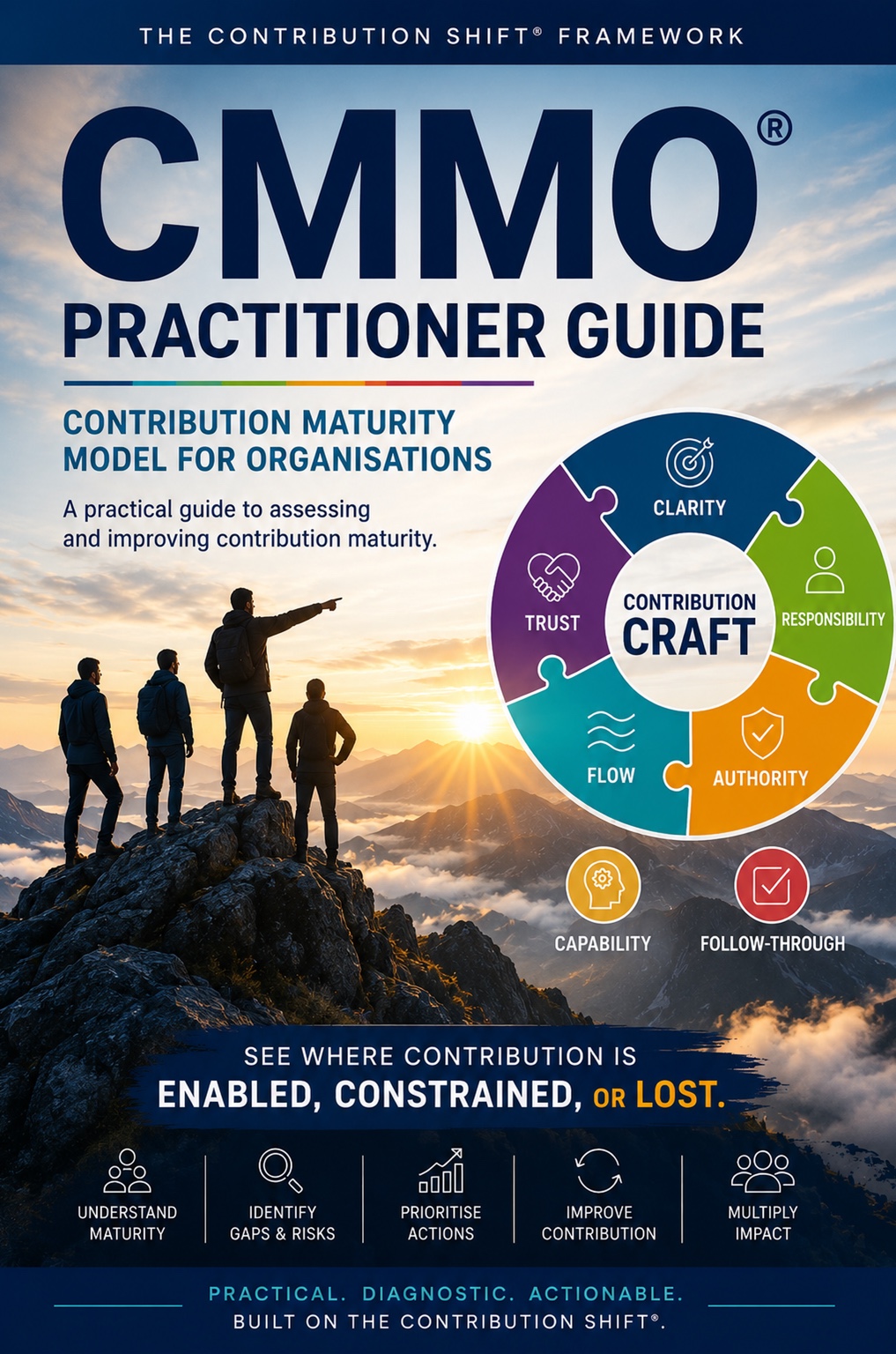
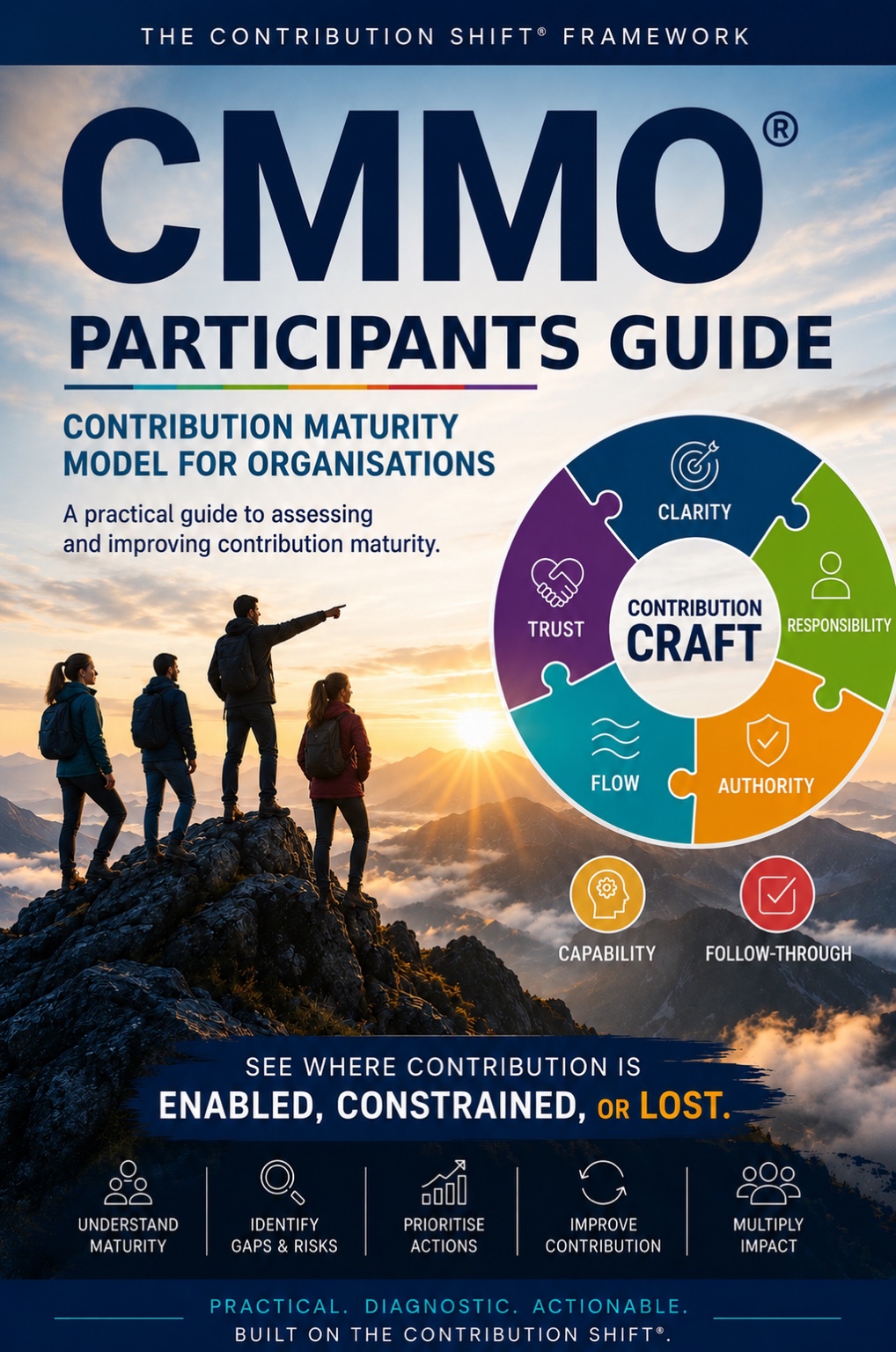
The CMMO® Practitioner Guide and CMMO® Participant Guide support facilitated training based on The Contribution Shift and the Contribution Maturity Model for Organisations.
These materials are designed to help facilitators guide practical discussion, maturity assessment, reflection, and action planning. They connect the CMMO® framework back to the book, the website, and the Contribution Shift iPhone app so the course does not remain theory — it becomes visible leadership practice.
Practitioner Guide
For the facilitator leading the CMMO® discussion, assessment, and action-planning work.
Participant Guides
One guide for each participant to capture insights, maturity observations, and next actions.
Copies of the Book
One copy of The Contribution Shift for each participant as the core framework reference.
Suggested course pack: 1 x Practitioner Guide, 10 x Participant Guides, and 10 x copies of The Contribution Shift. Participants are encouraged to use the iPhone application during and after the training event to turn the course material into practical action through Development Plans, one-on-ones, follow-up, and contribution-focused reflection.
The CMMO® slide pack is available upon request through the website support page to assist properly attributed internal education, facilitated discussion, and practitioner-supported workshops.
How to use it
CMMO® is designed to be practical. Use it as a lens for reflection, assessment, leadership development, team conversations, and organisational improvement. The aim is not to give the organisation a label. The aim is to make the next useful improvement visible.