Read and listen
Find the book, audiobook, retailer links and the full Leadership Intelligence framework.
Open the book and audiobook hubThe Missing Intelligence?
Leadership Intelligence (LI) is not another measure of the leader. It is the intelligence to recognise what contribution a situation requires — and create the conditions for others to provide it.
Read→Shift→Enable→Multiply
This page explains how Leadership Intelligence fits within The Contribution Shift. For the dedicated book, audiobook, app, Discussion Papers and practice experience, continue to the official Leadership Intelligence hub.
Find the book, audiobook, retailer links and the full Leadership Intelligence framework.
Open the book and audiobook hubStart with the Leadership Intelligence (LI) App and practise 500 leadership scenarios.
Try the LI App demoUse LI Mentor Lab for evidence-led judgement, Context Flips and workplace experiments.
Try LI Mentor LabIQ, emotional intelligence, social intelligence and artificial intelligence all expand what a leader can understand or do. None of them, by itself, answers the defining question: what contribution does this situation require?
Leadership Intelligence (LI) is not about how intelligent the leader is. It is the intelligence to recognise what contribution the situation requires — then Read, Shift, Enable and Multiply so that contribution can continue through others.
Leadership Intelligence (LI), as defined by Guy Pilens, is applied judgement. Sometimes the leader must direct, decide or protect. At other times the intelligent contribution is to question, coach, transfer authority, remove an obstacle, repair trust, change the system or step back. The response is intelligent only when it fits the contribution context.
The four-part cycle turns the idea of Leadership Intelligence (LI) into a practical discipline for the next conversation, decision, meeting or system challenge.
Read the situation before acting. What is actually happening? What contribution is required? Is the constraint clarity, capability, authority, trust, responsibility, flow or follow-through? Is intervention required from the leader at all?
Change your own form of contribution to fit the moment: from doing to enabling, answering to questioning, controlling to trusting, directing to coaching, solving to developing, or retaining authority to transferring it.
Create the conditions in which others can contribute successfully: clarity, appropriate authority, capability, trust, safety to speak, sound information flow, supported judgement, ownership and follow-through.
Look beyond today's solution. Ask what the organisation has become more capable of doing next time—and whether contribution will continue and grow through other people, teams and systems.
The Contribution Shift explains the transition from personal contribution towards contribution through others.
Leadership Intelligence provides the intelligence and judgement to recognise which form of contribution the situation requires—and when the leader must change their own contribution.
Together they shift the leadership question from “What can I personally do?” to “What contribution is needed here, and how do I create the conditions for it to occur?”
Listen in sequence or begin with the challenge in front of you. All three audiobooks are now available, with verified links to every current public listing below.
Distribution update: all three audiobooks are now live across multiple international platforms. Availability, pricing and subscription access may vary by country.
The Missing Intelligence?
The bridge from understanding people to multiplying contribution. Learn to Read what a situation requires, Shift your own contribution, Enable others and Multiply capability through people, teams and systems.
Listen to the 57-second trailer
Elevate Your Impact · Third Edition
The intellectual foundation for capable people moving from personal output towards contribution through others—while preserving the expertise, care and standards that helped them succeed.
Listen to a Chapter 1 sample
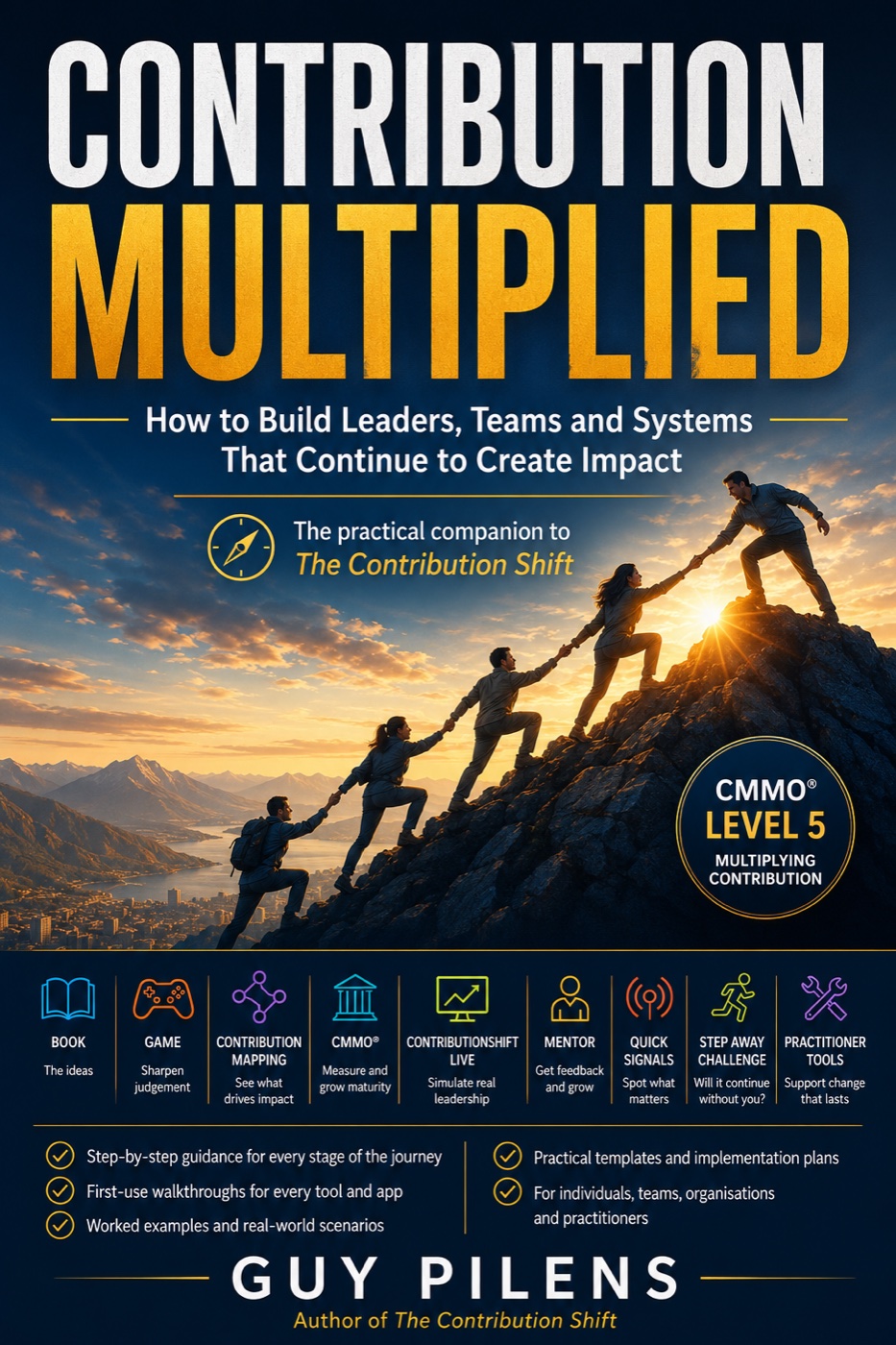
How to Build Leaders, Teams and Systems That Continue to Create Impact
The practical companion for choosing a starting point, applying the framework and tools, and turning contribution concepts into action across individuals, teams, organisations and practitioners.
Listen to a Chapter 1 sample
Choose an audiobook and your preferred listening platform. Every linked listing below has been publicly verified.
On a smaller screen, swipe sideways to see all three books.
| Storefront or service | The Contribution Shift | Contribution Multiplied | Leadership Intelligence |
|---|---|---|---|
| Audible Australia | Live | Live | Live |
| Audible United States | Live | Live | Live |
| Audible United Kingdom | Live | Live | Live |
| Audible Canada | Live | Live | Live |
| Audible Germany | Live | Live | Live |
| Audible France | Live | Live | Live |
| Audible Italy | Live | Live | Live |
| Audible Spain | Live | Live | Live |
| Audible Japan | Live | Live | Live |
| Audible India | Live | Live | Live |
| Amazon Australia | Live | Live | Live |
| Amazon United States | Live | Live | Live |
| Amazon United Kingdom | Live | Live | Live |
| Amazon Canada | Live | Live | Live |
| Amazon Germany | Live | Live | Live |
| Amazon France | Live | Live | Live |
| Amazon Italy | Live | Live | Live |
| Amazon Spain | Live | Live | Live |
| Amazon Japan | Live | Live | Live |
| Amazon India | Live | Live | Live |
| Apple Books — 22 verified countries | Live | Live | Live |
| Storytel International | Live | Live | Live |
| Nextory — selected European markets | Live | Live | Live |
| Mofibo Denmark | Live | Live | Live |
| Kobo — selected markets | Live | Live | Live |
| Libro.fm | Not verified | Live | Live |
| Everand | Live | Live | Live |
| Audiobooks.com | Not verified | Live | Live |
| Spotify Australia | Live | Live | Live |
| Google Play Audiobooks | Live | Live | Live |
| 24symbols | Live | Live | Live |
| Feltrinelli Italy | Live | Live | Live |
| IBS Italy | Live | Live | Live |
| bol — Netherlands & Belgium | Live | Live | Live |
| AudiobooksNow | Live | Live | Live |
| OverDrive / Libby catalogue | Not verified | Catalogued | Catalogued |
| Chirp | Listed—not available AU | Listed—not available AU | Listed—not available AU |
Live means the retailer listing was publicly verified on 9 September 2026. Catalogued means the title appears in the OverDrive/Libby acquisition catalogue; it does not mean a particular library currently offers it. Not verified means no public listing was found during this audit; it does not confirm rejection or permanent unavailability. Apple Books links use the Australian storefront as the representative listing; availability was also verified in Austria, Belgium, Canada, Denmark, Finland, France, Germany, Greece, Ireland, Italy, Japan, Luxembourg, the Netherlands, New Zealand, Norway, Portugal, Spain, Sweden, Switzerland, the United Kingdom and the United States. Nextory is verified across selected European markets. Kobo links use Australian storefronts where available, and retailer pages may redirect according to the visitor's country or account marketplace. bol links use the Netherlands storefront as the representative listing; all three titles were also verified in Belgium. Availability, pricing and subscription access vary by country. Chirp currently lists all three titles but does not make them available in Australia.
The books share an interest in effective leadership and helping others perform, but they are separate works by different authors, with distinct frameworks, terminology and organising lenses.
| Area | Caroline Webb | Guy Pilens |
|---|---|---|
| Full title | Leadership Intelligence: Science-Backed Strategies for Mastering 21 Everyday Management Challenges | Leadership Intelligence: The Missing Intelligence? |
| Primary lens | Psychology, neuroscience and behavioural economics | Contribution, judgement, stewardship and organisational capability |
| Organising structure | Six brain-based principles, organised around Wisdom, Inspiration and Resilience | Read, Shift, Enable and Multiply |
| Application | Science-backed tools for 21 everyday management challenges | Recognising the required contribution, shifting the leader's role and creating conditions for others to contribute |
| Intended result | More effective choices, interactions and leadership responses | Contribution through others that strengthens people, teams and systems beyond the leader |
For Caroline Webb's own description of her framework, visit her official Leadership Intelligence book page.
On The Contribution Shift website, Leadership Intelligence (LI) refers to the leadership framework developed by Australian author Guy Pilens. It defines Leadership Intelligence as the ability to recognise the contribution a situation requires, shift one's own contribution, enable contribution through others, and multiply capability across teams and organisations.
This framework is distinct from Caroline Webb's book Leadership Intelligence: Science-Backed Strategies for Mastering 21 Everyday Management Challenges. Webb's work presents a science-backed system grounded in psychology, neuroscience and behavioural economics; Pilens' framework approaches leadership through contribution, judgement, stewardship and organisational capability.
Leadership begins by reading what the situation requires, rather than repeating the response that previously made the leader successful.
Transferring contribution does not remove accountability. It clarifies the outcome, authority, boundaries, support and evidence needed for others to carry real weight.
The final test is what becomes stronger and what continues when the leader is not present—not simply how much the leader personally delivered.
Leadership Intelligence (LI), as defined by Guy Pilens, is the ability to recognise what contribution a situation requires, shift how you contribute, enable others to contribute, and multiply capability through people, teams and systems.
Leadership Intelligence: The Missing Intelligence? was written by Australian author Guy Pilens.
LI stands for Leadership Intelligence. It describes the intelligence required to Read, Shift, Enable and Multiply contribution.
Read the situation and required contribution. Shift your own form of contribution. Enable other people to contribute successfully. Multiply capability so contribution continues beyond the leader.
The Contribution Shift describes the transition from personal contribution towards contribution through others. Leadership Intelligence provides a framework for recognising when and how that shift should occur.
No. They are separate books by different authors that share a main title. Caroline Webb's book presents a science-backed system for everyday management challenges, organised around Wisdom, Inspiration and Resilience. Guy Pilens' book presents a contribution-based framework organised around Read, Shift, Enable and Multiply.
Yes. Leadership Intelligence (LI): The Missing Intelligence? by Guy Pilens is available through Audible and Amazon marketplaces in Australia, the United States, the United Kingdom, Canada, Germany, France, Italy, Spain, Japan and India; Apple Books in 22 verified countries; Google Play Audiobooks; Storytel; Nextory in selected European markets; Mofibo; Kobo in selected markets; Libro.fm; Everand; Audiobooks.com; AudiobooksNow; 24symbols; Feltrinelli; IBS; bol in the Netherlands and Belgium; and Spotify Australia. It is also catalogued for library acquisition by OverDrive and Libby. Chirp carries an international catalogue listing but is not currently available in Australia. Availability may vary by country.
Explore the connected books, frameworks and practical tools in The Contribution Shift ecosystem.